
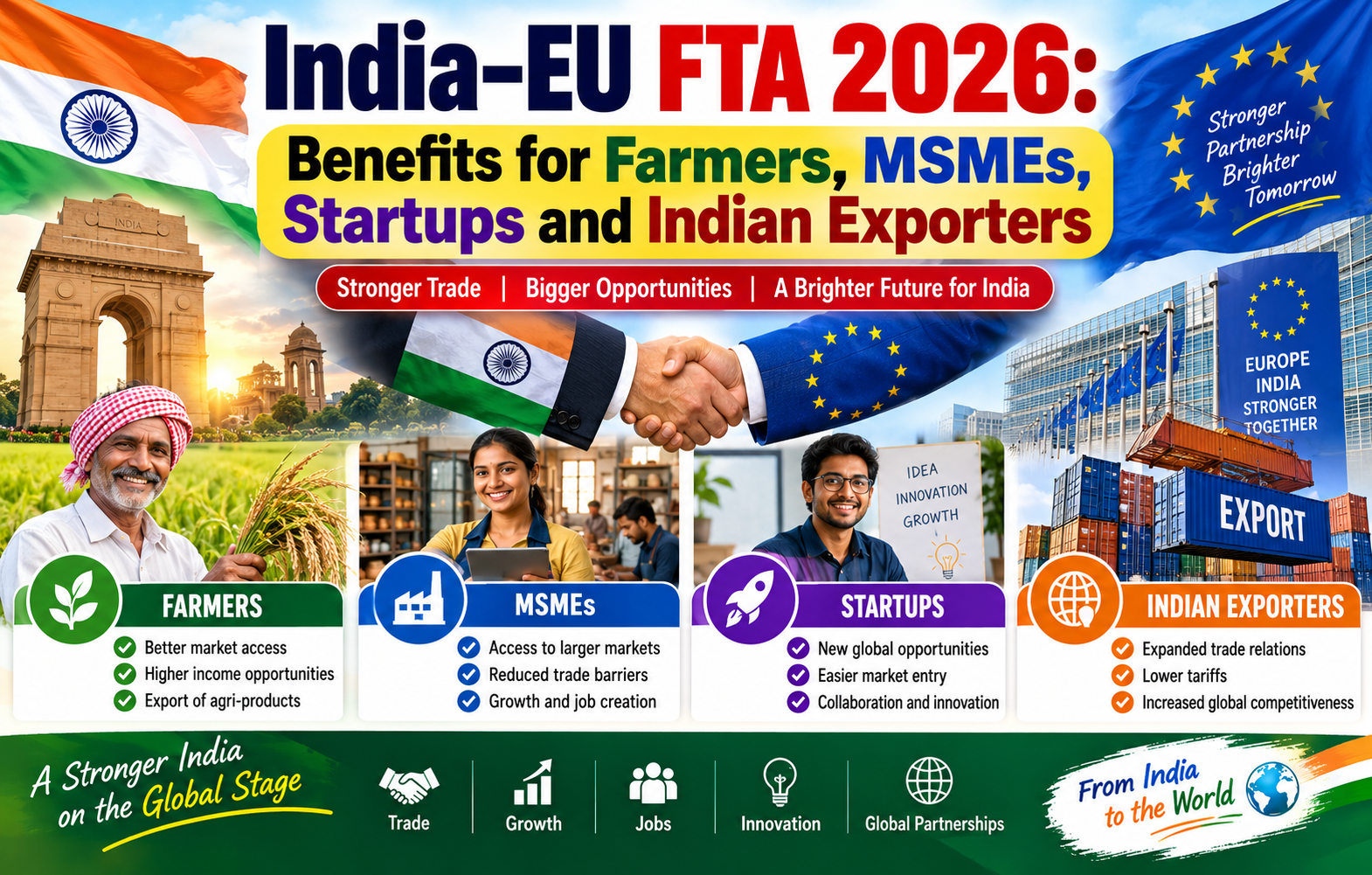
India’s economic relationship with Europe is entering an important new phase following the conclusion of negotiations on the India–European Union Free Trade Agreement (FTA). The agreement is expected to expand opportunities for Indian farmers, MSMEs, manufacturers, startups, innovators and service providers while creating deeper trade and investment links between India and the 27-member European Union.
Union Commerce and Industry Minister Piyush Goyal, speaking at the India–Belgium High-Level Dialogue on the India–EU FTA in Mumbai on September 4, 2026, said the agreement opens significant opportunities for businesses and workers on both sides.
Belgian Prime Minister Bart De Wever, who attended the dialogue, also highlighted the potential of the agreement to strengthen trade, investment and economic resilience.
The scale is substantial. According to the Press Information Bureau (PIB), the India–EU FTA brings together a market of approximately 2 billion people, representing around one-quarter of global GDP and one-third of world trade, with a combined market estimated at USD 24 trillion.
For India, the implications extend well beyond conventional exports. Agriculture, food processing, MSMEs, pharmaceuticals, semiconductors, green hydrogen, advanced manufacturing, gems and jewellery, services and technology could all become important areas of India–Europe economic cooperation.
Here is what businesses, entrepreneurs, farmers and exporters need to know about the India–EU Free Trade Agreement in 2026.
What Is the India–EU Free Trade Agreement?
A Free Trade Agreement is an arrangement between countries or economic blocs designed to reduce trade barriers and establish agreed rules for commercial relations.
Depending on its provisions, an FTA can address areas such as tariffs, goods, services, investment, standards, intellectual property, customs procedures and market access.
The India–EU FTA aims to deepen economic relations between India and the European Union’s 27 member countries.
The importance of the agreement comes partly from the size of the two economies.
According to the September 2026 PIB release, the combined India–EU market covers approximately 2 billion people and represents about one-quarter of global GDP and one-third of global trade.
India’s trade with the EU has also doubled over the last decade to nearly USD 140 billion, according to Commerce Minister Piyush Goyal.
India–EU FTA 2026: Key Highlights
| Particular | Key Information |
|---|---|
| Agreement | India–European Union Free Trade Agreement |
| Parties | India and 27 EU member countries |
| Negotiation Journey | Around 25 years |
| Combined Population/Market | Around 2 billion people |
| Combined Market Size | About USD 24 trillion |
| Share of Global GDP | Around one-quarter |
| Share of World Trade | Around one-third |
| India–EU Trade | Nearly USD 140 billion |
| Key Beneficiaries Highlighted | Farmers, MSMEs, startups, innovators, manufacturers and service providers |
| Important Sectors | Agriculture, food processing, pharmaceuticals, gems & jewellery, semiconductors, green hydrogen, advanced manufacturing and services |
The agreement still needs to go through the required formal processes before coming into force. Businesses should therefore distinguish between the conclusion of negotiations and the date on which particular tariff or market-access provisions actually become operational.
More Than 95% of Goods Exports Could See Tariff Reductions
One of the most important aspects highlighted at the India–Belgium dialogue concerns tariffs.
Belgian Prime Minister Bart De Wever said that tariffs on more than 95% of Indian and European goods exports would be scrapped or reduced.
Lower tariffs can make exported goods more price-competitive in overseas markets.
For example, if an Indian product currently attracts an import tariff in an EU market and the applicable tariff is reduced under the FTA, the product may become more competitive relative to alternatives.
However, tariff reductions do not automatically guarantee higher exports.
Indian companies still need to meet European requirements concerning product standards, quality, certification, safety, sustainability and other applicable regulations.
What Does the India–EU FTA Mean for Indian MSMEs?
Micro, small and medium enterprises form a major part of India’s manufacturing and employment ecosystem.
The India–EU FTA could potentially improve opportunities for MSMEs by providing better access to European markets.
Potential advantages include:
- Reduced tariffs on eligible exports
- Greater access to European customers
- Opportunities to join international supply chains
- Technology partnerships
- Investment opportunities
- Collaboration with European companies
- Export diversification
For a small Indian manufacturer, access to a large European market can create significant opportunities.
But SMEs should prepare early.
Entering the EU market can require product certifications, documentation, packaging compliance, environmental standards and consistent quality.
The FTA can reduce certain trade barriers, but companies will still need to build competitive products.
Opportunities for Indian Farmers
Agriculture and food processing were specifically highlighted during the India–Belgium High-Level Dialogue.
Piyush Goyal pointed to opportunities ranging from potato processing and cold chains to broader food processing and sustainable agricultural value chains.
For Indian farmers, greater international market access can potentially create demand for agricultural products and processed foods.
However, the benefits are likely to depend heavily on supply-chain development.
Selling agricultural products internationally requires more than production.
Farmers and agricultural businesses may need:
- Efficient cold-chain infrastructure
- Modern storage
- Food-processing facilities
- Traceability
- Quality control
- Appropriate packaging
- Certification
- Export logistics
- Compliance with EU food standards
Farmer Producer Organisations, food processors and agricultural exporters could therefore become important links between farms and European markets.
Food Processing Could Become a Major Opportunity
Food processing is particularly important because processed agricultural products can create more value than exports of unprocessed commodities.
India and Belgium have opportunities to cooperate in potato processing, cold chains and other areas of food processing.
Belgium has established expertise in food-processing technologies, while India has a large agricultural base and consumer market.
Combining Indian agricultural production with improved processing technology, storage and logistics could help create products suitable for both domestic consumption and exports.
Such collaboration could also potentially reduce post-harvest losses and increase value addition within India.
Why Belgium Matters to India–EU Trade
Belgium’s role goes beyond bilateral trade.
Its geographic location and logistics infrastructure make it an important entry point into the wider European market.
The Port of Antwerp-Bruges was highlighted at the dialogue as a key logistical connection between India and Europe.
Piyush Goyal described the port as an important gateway through which the opportunities created by the FTA could physically move between Europe and India.
The port combines inland barge, rail and road networks with deepwater and roll-on/roll-off capabilities.
For Indian exporters, efficient access through a major European logistics hub can make it easier to reach customers across the continent.
Gems, Jewellery and Lab-Grown Diamonds
Gems and jewellery are another area identified for deeper India–Belgium cooperation.
Belgium’s Antwerp is one of the world’s best-known diamond trading centres, while Mumbai and Surat are major centres of India’s diamond and jewellery industry.
The two countries could expand cooperation in:
- Jewellery design
- Diamond processing
- Lab-grown diamonds
- Certification
- Technology
- Mutual recognition of standards
Lab-grown diamonds are particularly noteworthy because they represent an emerging area where manufacturing technology, design, certification and global distribution networks intersect.
Stronger connections between Antwerp, Mumbai and Surat could help businesses develop new products and reach additional markets.
Semiconductor Cooperation
Semiconductors are another strategic area highlighted during the dialogue.
Belgium has significant capabilities in microelectronics research, while India is investing heavily in developing a domestic semiconductor ecosystem.
Goyal suggested combining Belgium’s technological capabilities with India’s scale, talent and skills to develop a broader design-to-fabrication semiconductor ecosystem.
The PIB release also highlighted India’s expanding semiconductor investment programme.
According to the minister, Semicon India 2.0 has been launched with an outlay of around USD 14 billion, and the overall mission is expected to catalyse nearly USD 70 billion in semiconductor investment.
A stronger India–Europe technology partnership could therefore extend beyond trade in finished products to research, design, manufacturing and supply-chain development.
Green Hydrogen and Clean Energy
Green hydrogen is another potential area for India–Belgium collaboration.
India has been developing its green-hydrogen ecosystem, while European economies are seeking cleaner alternatives to fossil fuels.
The Port of Antwerp-Bruges has infrastructure relevant to bunkering, shipping and energy logistics.
Goyal highlighted the possibility of connecting India’s green-hydrogen ambitions with Belgium’s infrastructure and Europe’s future energy requirements.
Such cooperation could involve technology, production, transportation, storage and industrial use.
The opportunity will depend on cost competitiveness, infrastructure, regulation and the development of a reliable international hydrogen supply chain.
Opportunities for Startups and Innovators
The FTA is not only about traditional manufacturers and exporters.
Startups, technology companies and innovators were explicitly identified among the potential beneficiaries.
Indian startups can potentially use stronger India–EU commercial ties to explore:
- European customers
- Cross-border partnerships
- Research collaboration
- Investment
- Technology licensing
- Joint product development
- Innovation programmes
India’s growing artificial intelligence, semiconductor, space and research ecosystems could be particularly relevant.
The PIB release notes that India’s AI Mission is operational and supporting startups, while the country is also expanding activity in critical minerals, semiconductor manufacturing, space technology and research.
India’s Space Economy Could Benefit From Deeper Partnerships
Space technology represents another high-growth sector.
According to figures cited by Piyush Goyal, India’s space technology sector is currently valued at approximately USD 8.5 billion and is expected to grow to around USD 44 billion over the next eight years.
Much of this growth is expected to come from private companies, startups, innovators and designers.
Closer economic cooperation with European countries could create opportunities for joint research, investment, component manufacturing, satellite technologies and commercial space services.
Pharmaceuticals and Healthcare Industries
Belgian Prime Minister Bart De Wever identified pharmaceuticals among the sectors that could benefit from stronger India–EU trade relations.
India has a large pharmaceutical manufacturing industry, while Europe represents an important global market for healthcare products.
Tariff improvements can support trade, but pharmaceutical exports are also heavily dependent on regulatory approvals, manufacturing standards and quality requirements.
Indian pharmaceutical businesses seeking European opportunities therefore need to consider both trade preferences and EU regulatory compliance.
Advanced Manufacturing and Industrial Cooperation
The India–Belgium discussions also covered advanced manufacturing.
India is seeking to expand its position as a global manufacturing destination, while European companies possess significant technology, capital and engineering expertise.
Closer economic ties could encourage:
- Joint manufacturing
- Technology transfer
- Co-design
- Research partnerships
- Investment
- Supply-chain integration
This could allow companies to develop products in India not only for India’s domestic market but also for Europe and other international markets.
What Does the FTA Mean for Indian Exporters?
The biggest practical question for businesses is whether the agreement will make exporting to Europe easier.
For many sectors, lower tariffs and improved market access could certainly help.
But Indian exporters should not assume that an FTA eliminates every barrier.
Businesses preparing for European markets should focus on:
Product Standards
Products must comply with applicable European standards.
Certification
Some categories require specific testing and certification before they can be sold.
Rules of Origin
Exporters need to understand whether their goods qualify for preferential tariff treatment under the agreement’s rules of origin.
Documentation
Accurate customs and trade documentation remains essential.
Sustainability Requirements
Environmental and sustainability standards are increasingly important in European markets.
Logistics
Companies need reliable and cost-effective shipping routes.
The FTA creates opportunities, but businesses capable of meeting regulatory and quality requirements will be best positioned to use them.
India–Belgium Economic Relationship
India and Belgium have maintained diplomatic relations since the early years of independent India.
At the Mumbai dialogue, Goyal noted that Belgium was among the early European countries to establish diplomatic relations with India after independence.
Today, the economic relationship extends across diamonds, pharmaceuticals, technology, logistics, manufacturing, energy and other industries.
The India–EU FTA provides a broader framework within which this bilateral relationship can expand.
Belgian technology, innovation and capital combined with India’s scale, workforce and growing consumer economy could support new forms of industrial cooperation.
Workforce Mobility and Skills
Trade agreements ultimately involve people as well as goods.
Goyal called for stronger cooperation in:
- Workforce mobility
- Mutual recognition of qualifications
- Joint skill development
- Dual-degree education programmes
These areas could become particularly relevant in sectors where European countries face shortages of skilled workers.
Greater recognition of qualifications and structured mobility arrangements could potentially create opportunities for Indian professionals, researchers and students.
However, immigration, professional licensing and work-authorisation requirements remain subject to applicable laws and agreements.
Is the India–EU FTA Already in Force?
This distinction is important.
The September 4, 2026 PIB announcement says that negotiations had concluded after a process spanning roughly 25 years.
It also says all 27 EU countries were supportive and wanted the remaining formalities completed so that the agreement could be brought into force as soon as possible.
Therefore, businesses should not assume every announced tariff reduction is already available simply because negotiations have concluded.
The relevant legal and implementation procedures still need to be completed.
Exporters should check official government notifications before claiming preferential tariff treatment.
What Indian Businesses Should Do Now
Indian companies interested in Europe can use this period to prepare.
Businesses should identify the EU countries where demand exists for their products, understand current tariff structures, examine applicable standards and certifications, and evaluate logistics costs.
Manufacturers should also examine whether their supply chains will satisfy the agreement’s eventual rules-of-origin requirements.
MSMEs that have never exported before may benefit from strengthening quality-control systems and developing export documentation capabilities.
The companies that prepare before implementation may be better positioned to take advantage of new market-access opportunities when applicable provisions take effect.
Frequently Asked Questions
What is the India–EU FTA?
The India–EU FTA is a Free Trade Agreement between India and the European Union intended to reduce trade barriers and strengthen economic relations.
How large is the combined India–EU market?
According to the September 2026 PIB release, the agreement brings together approximately 2 billion people and a market estimated at USD 24 trillion.
How much trade does India have with the EU?
Commerce Minister Piyush Goyal said India–EU trade has doubled over the last decade to nearly USD 140 billion.
Will tariffs be reduced?
Belgian Prime Minister Bart De Wever said tariffs on more than 95% of Indian and European goods exports would be scrapped or reduced under the FTA.
Who could benefit from the India–EU FTA?
Potential beneficiaries highlighted by the government include farmers, fishermen, MSMEs, small industries, startups, innovators, women entrepreneurs, manufacturers and service providers.
Which industries have major opportunities?
Sectors highlighted include agriculture, food processing, gems and jewellery, semiconductors, pharmaceuticals, green hydrogen, maritime services, infrastructure and advanced manufacturing.
Why is Belgium important for Indian exporters?
Belgium hosts the Port of Antwerp-Bruges, a major European logistics hub that can act as a gateway for Indian exports to European markets.
Is the India–EU FTA already operational?
The September 2026 PIB release says negotiations have concluded, but remaining formalities need to be completed before the agreement is brought into force. Businesses should therefore check official notifications before assuming preferential tariffs are available.
Conclusion
The India–EU Free Trade Agreement has the potential to become one of India’s most consequential international trade arrangements.
By connecting India with the European Union’s 27-member market, the agreement brings together approximately 2 billion people, a USD 24 trillion market, about one-quarter of global GDP and one-third of world trade, according to the Government of India.
The opportunities extend across agriculture, food processing, MSMEs, pharmaceuticals, gems and jewellery, semiconductors, green hydrogen, startups, technology, advanced manufacturing and services.
For Indian exporters, tariff reductions could improve competitiveness. But lower tariffs alone will not guarantee success. Businesses will still need to meet European standards, certification requirements, rules of origin and other regulatory obligations.
The conclusion of negotiations is therefore a major milestone rather than the end of the process. The remaining formalities must be completed before the agreement comes into force.
For farmers, entrepreneurs, MSMEs and established exporters, the coming period provides an opportunity to understand European markets, improve product standards and prepare for the commercial opportunities that the India–EU FTA could create.