
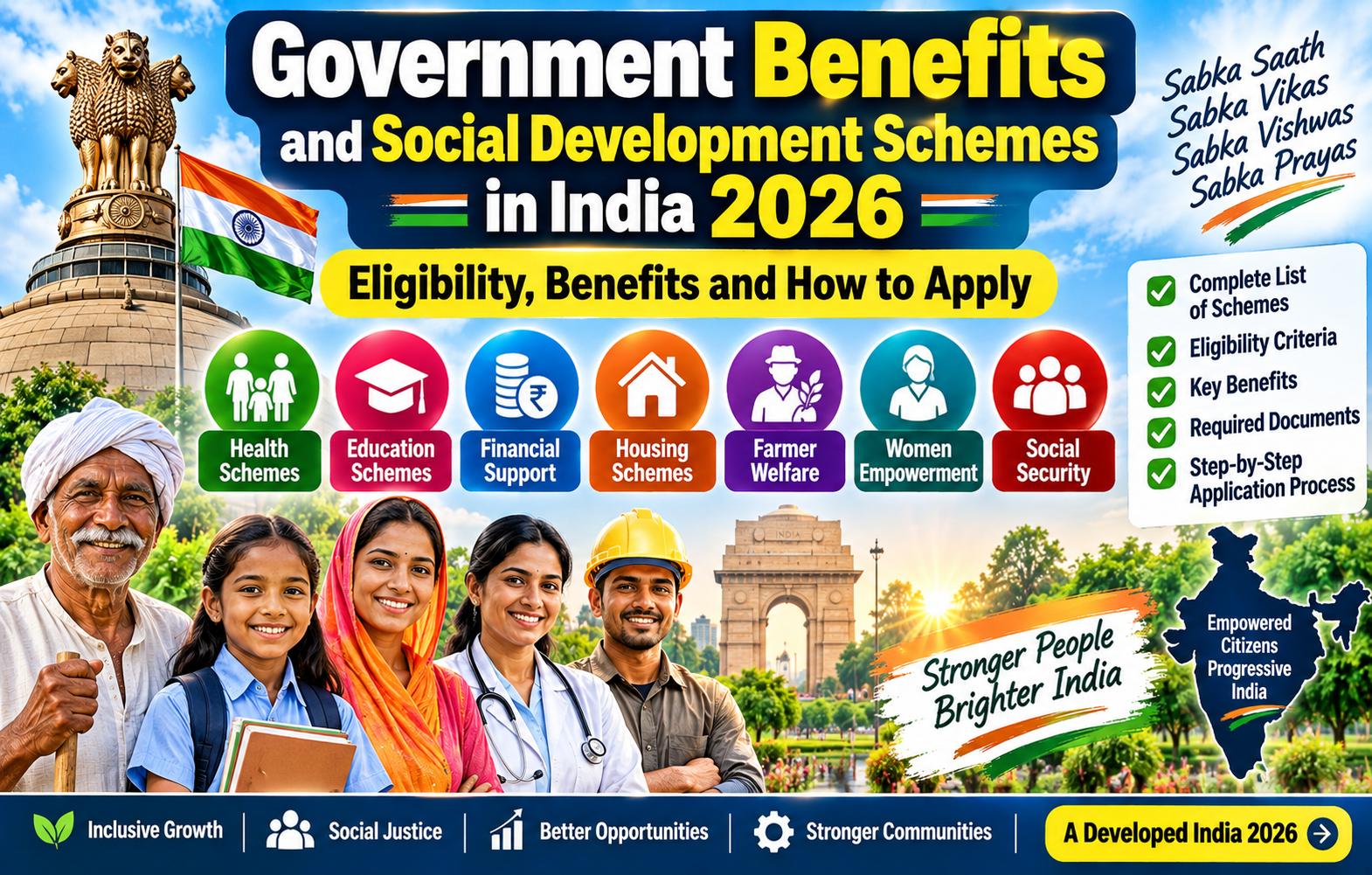
Government benefits and social development programmes play an important role in supporting citizens who need financial assistance, social security, education, healthcare, livelihood opportunities and other forms of welfare support. In India, hundreds of Central and State government programmes operate across different beneficiary groups, making it difficult for an individual to know which schemes may apply to them.
The National Portal of India (India.gov.in) provides a central place where citizens can explore information about government benefits, grants, subsidies and social-development services. Its Benefits & Social Development category brings together resources for senior citizens, persons with disabilities, women and children, migrants, minorities and other communities.
The portal can also direct citizens towards services such as scholarship applications, pension-related facilities, e-Shram registration and information about welfare programmes.
This guide explains the major categories of government benefits and social development schemes in India in 2026, who may qualify, how to find suitable schemes, documents commonly required and how to apply safely through official government channels.
What Are Government Benefits and Social Development Schemes?
Government benefits are programmes created to provide financial or non-financial assistance to eligible individuals, families and communities.
Depending on the programme, assistance can take the form of:
- Direct financial assistance
- Pensions
- Scholarships
- Subsidies
- Healthcare support
- Food security
- Housing assistance
- Skill development
- Livelihood support
- Assistive devices
- Social protection
- Grants
- Rehabilitation services
Social development has a broader objective. Instead of focusing only on immediate financial assistance, social-development initiatives can help improve education, employment opportunities, health, independence, social inclusion and overall quality of life.
The Government of India and State Governments operate different programmes according to their respective responsibilities.
Benefits & Social Development on the National Portal of India
The National Portal of India is designed and maintained by the National Informatics Centre (NIC) under the Ministry of Electronics & Information Technology.
The portal brings together government information from different Ministries and Departments so citizens can access resources without having to know the responsible department beforehand.
Under its Benefits & Social Development category, the portal currently organises information into six major areas:
- Senior Citizens
- Persons with Disabilities
- Women & Children
- Migrants & Visitors
- Minorities, Castes & Tribes
- Benefits, Grants & Subsidies
This structure makes it easier for users to start with their needs or beneficiary category and then explore relevant government services.
1. Government Benefits for Senior Citizens
Senior citizens may require additional financial, healthcare and social support after retirement or as they grow older.
Government initiatives for older persons can include pensions, healthcare services, financial assistance, institutional support and other welfare measures.
The National Portal of India provides a dedicated Senior Citizens section under Benefits & Social Development.
Depending on eligibility and location, citizens may find information concerning areas such as:
- Pension and retirement services
- Financial assistance
- Healthcare
- Senior citizen welfare
- Travel-related facilities
- Social-security programmes
- Savings-related information
- Institutional and community support
Government programmes for older persons are administered through multiple Ministries, Departments and State Governments, so there is no single eligibility rule that applies to every benefit.
Applicants should check the specific age, income, residence and other conditions of each programme.
2. Benefits for Persons with Disabilities
Government welfare programmes for persons with disabilities can cover education, assistive devices, rehabilitation, scholarships, skills, accessibility and economic empowerment.
The National Portal links citizens to disability-related government information and online services.
One example highlighted on the portal is an online facility for scholarships for persons with disabilities.
Other government initiatives may provide support for aids and assistive appliances, rehabilitation and other eligible requirements.
However, disability eligibility can depend on the nature and benchmark of disability prescribed under the applicable programme.
Applicants may therefore need a valid disability certificate or Unique Disability ID (UDID) and other supporting documentation where prescribed.
3. Government Schemes for Women
Women-focused government programmes cover a broad range of social and economic objectives.
Depending on the scheme, benefits may focus on:
- Women’s safety
- Maternal welfare
- Nutrition
- Education
- Skill development
- Entrepreneurship
- Financial inclusion
- Shelter and rehabilitation
- Employment
- Self-help groups
- Social security
The National Portal of India provides access to resources associated with the Ministry of Women and Child Development and other government bodies.
Importantly, there is no universal eligibility criterion for “women’s schemes.”
A programme designed for pregnant women will have different eligibility conditions from an entrepreneurship scheme, scholarship or widow pension.
Applicants should therefore identify the purpose of a scheme before checking eligibility.
4. Government Benefits for Children
Government support for children is not limited to direct cash assistance.
Child-focused programmes can address nutrition, health, education, protection and development.
Some programmes are delivered through institutions such as schools or Anganwadi centres, while others require applications from parents or guardians.
Government child-development initiatives can include support relating to:
- Nutrition
- Early childhood care
- School education
- Scholarships
- Child protection
- Girl-child welfare
- Health
- Adoption and care services
- Protection from exploitation
The National Portal also provides access to a facility for registering complaints concerning child-rights violations.
Parents should always verify whether a benefit is administered by the Central Government, State Government, school, local authority or another implementing agency.
5. Scholarships and Educational Benefits
Scholarships are among the most important social-development benefits available to students.
Different scholarships can be based on:
- Family income
- Academic performance
- Social category
- Disability
- Gender
- Course
- Institution
- State of residence
- Minority status
- Other programme-specific conditions
The National Portal of India currently links users to the National Scholarship Portal (NSP) for scholarship-related services, including application-status facilities.
Students should be particularly careful about application deadlines.
A student may satisfy the eligibility conditions but still lose an opportunity if the application, institution verification or required documentation is not completed within the prescribed timeline.
6. Benefits for Minorities, Castes and Tribes
Social-development programmes also provide targeted assistance to eligible communities.
Depending on the programme and competent authority, support may relate to:
- Education
- Scholarships
- Hostels
- Skill development
- Entrepreneurship
- Financial assistance
- Livelihood development
- Community development
For example, the National Portal provides information relating to welfare programmes for backward classes, including pre-matric and post-matric scholarships and other development initiatives.
Applicants should not assume that possession of a particular certificate automatically qualifies them for every programme.
Eligibility can additionally depend on income, age, education, residence, course, institution and other factors.
7. Benefits, Grants and Subsidies
The Benefits, Grants & Subsidies subcategory is useful for citizens looking specifically for government financial assistance.
The term “government benefit” does not necessarily mean that money will be deposited directly into a beneficiary’s bank account.
Government assistance may be delivered through:
- Direct Benefit Transfer (DBT)
- Subsidised services
- Scholarships
- Pension payments
- Grants
- Interest support
- Reimbursements
- Equipment or assistive devices
- Institutional assistance
Each programme has its own benefit structure.
Before applying, citizens should check exactly what assistance is offered rather than relying on social-media posts that advertise a scheme as “free money.”
Internal link: Direct Benefit Transfer (DBT): How Government Payments Work
8. e-Shram and Support for Unorganised Workers
The National Portal’s Benefits & Social Development section also links citizens to e-Shram registration.
e-Shram is an important government platform associated with unorganised workers.
Workers should understand that registering on a government database and qualifying for a particular cash benefit are not always the same thing.
An e-Shram registration can help create a worker record and connect eligible workers with the broader social-security ecosystem, but individual benefits remain subject to the conditions of the relevant programmes.
Always use the official government registration facility when submitting personal information.
How to Find Government Schemes You Are Eligible For
Finding a government scheme can sometimes be more difficult than applying for one.
Citizens may know that assistance exists but not know its official name or responsible department.
Two government platforms can be particularly useful.
National Portal of India
Visit the National Portal of India and open the Government Schemes or Benefits & Social Development section.
You can explore information by category and beneficiary type.
myScheme
The Government of India’s myScheme platform is another useful scheme-discovery service.
It allows users to provide basic eligibility-related information and discover government schemes that may be relevant to them.
External link: myScheme – Government Scheme Discovery Portal
Using official discovery platforms is safer than searching random websites for terms such as “₹10,000 government scheme” or “free money scheme.”
How to Apply for a Government Benefit
There is no single application procedure for all social-development schemes.
A typical process looks like this:
Step 1: Find the Scheme
Start with India.gov.in, myScheme or the official website of the responsible Ministry or Department.
Step 2: Read Eligibility Conditions
Check all conditions before completing the application.
These can include:
- Age
- Gender
- Family income
- State or district
- Social category
- Disability status
- Occupation
- Educational qualification
- Landholding
- Marital status
Step 3: Prepare the Documents
Collect the required supporting records.
Step 4: Apply Through the Authorised Channel
Some schemes allow complete online applications.
Others may require applications through a State Government portal, local office, school, bank, Common Service Centre or another authorised institution.
Step 5: Save Your Application Number
After submitting the form, keep the acknowledgement, registration number or application ID.
Step 6: Track the Application
If an online status service is available, use the official portal to monitor your application.
Documents Commonly Required for Government Schemes
Document requirements vary significantly between schemes, but applicants may commonly encounter requirements for:
- Aadhaar
- Mobile number
- Bank account/passbook
- Passport-size photograph
- Income certificate
- Residence/domicile certificate
- Age proof
- Disability certificate
- Caste/category certificate
- Educational records
- Ration card
- Land or occupation-related documents
This does not mean every scheme requires all these documents.
Always follow the official checklist for the specific benefit.
Why Bank and Aadhaar Details Matter
Many government benefits use Direct Benefit Transfer to send eligible payments directly to beneficiary accounts.
Applicants should therefore check their bank information carefully.
A small mistake in the account number, IFSC, beneficiary name or other required details can potentially create problems during payment processing.
Never share your banking password, ATM PIN or UPI PIN with anyone claiming that it is required to receive a government benefit.
Central vs State Government Schemes
A frequent source of confusion is the difference between Central and State government benefits.
Central Government schemes may operate nationally, although eligibility and implementation can still vary.
State Government schemes generally apply to eligible residents of the respective state.
A person may potentially qualify for both Central and State programmes, depending on the applicable rules.
The National Portal allows citizens to explore government resources from different levels, while individual scheme pages provide more specific details.
Beware of Fake Government Scheme Websites
Fraudsters frequently misuse the names of government schemes.
A fake message may claim:
“Every citizen will receive ₹50,000.”
It may then ask users to click a link and enter Aadhaar, card or banking information.
Never assume a scheme is genuine because a message contains a government logo or a photograph of a public official.
Verify the programme through an official government website.
As a general precaution, look for authentic government domains and verify the responsible department before entering sensitive information.
Never disclose:
- OTP
- UPI PIN
- ATM PIN
- Internet banking password
- Card PIN
A legitimate benefit transfer does not require your UPI PIN to receive money.
Frequently Asked Questions
What is the Benefits & Social Development section on India.gov.in?
It is a National Portal of India category that brings together government information on benefits, subsidies and social-development support for different sections of society.
What categories are available?
The portal currently lists Senior Citizens, Persons with Disabilities, Women & Children, Migrants & Visitors, Minorities/Castes/Tribes and Benefits/Grants/Subsidies.
Can I apply for schemes directly from India.gov.in?
It depends on the service. India.gov.in primarily acts as an information and access portal. Where an online government service is available, it can direct users to the appropriate official facility.
How can I find schemes for which I am eligible?
You can explore Government Schemes on India.gov.in or use the government’s myScheme platform to discover potentially relevant programmes.
Are all government schemes available to everyone?
No. Every scheme has specific eligibility conditions.
Do government schemes always provide cash?
No. Benefits may include subsidies, scholarships, pensions, healthcare, assistive devices, training, services or other forms of assistance.
Is there a fee for every government scheme application?
No. Fees and application procedures vary. Do not pay an individual simply because they claim a payment is required to “release” a government benefit.
Where should I check the latest scheme rules?
Use the official website of the Ministry, Department or government agency responsible for the programme.
Conclusion
The Benefits & Social Development section of the National Portal of India can be a useful starting point for citizens trying to understand the wide range of government welfare services available in India.
Instead of focusing on a single beneficiary group, the section brings together resources for senior citizens, persons with disabilities, women and children, migrants and visitors, minorities, castes and tribes, along with broader information on benefits, grants and subsidies.
Citizens can also access or discover important services involving scholarships, pensions, social security and other welfare programmes.
However, finding a scheme is only the first step. Before applying, always check the latest eligibility criteria, required documents, application deadline and official implementing authority.
For reliable information, begin with official Government of India platforms such as India.gov.in and myScheme, and follow the official application link provided for the specific programme. Avoid unofficial websites that promise guaranteed approval or ask for sensitive banking credentials.