
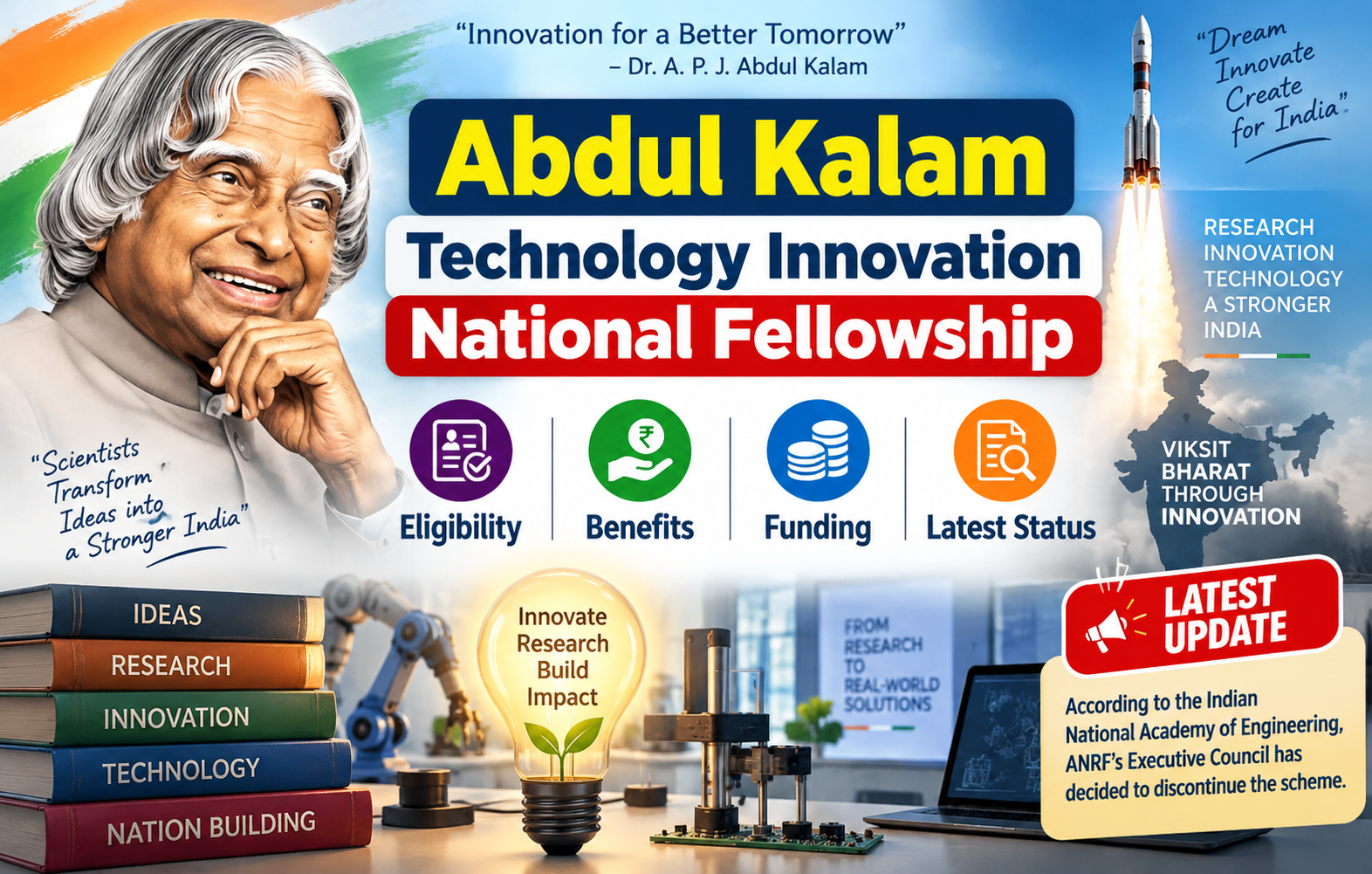
India has introduced several research-support programmes over the years to encourage scientists, engineers and innovators to turn promising ideas into technologies with practical applications. One notable initiative in this area was the Abdul Kalam Technology Innovation National Fellowship, created to recognise outstanding engineering professionals and support translational research in India.
Named after former President of India and renowned scientist Dr. A.P.J. Abdul Kalam, the fellowship focused particularly on engineering innovation, technology development, prototypes, patents and technologies capable of moving beyond the laboratory.
The programme offered substantial financial support, including a monthly fellowship amount and an annual research grant. However, prospective applicants should be aware of an important change in its current status.
According to the Indian National Academy of Engineering (INAE), the Science and Engineering Research Board (SERB) has been subsumed into the Anusandhan National Research Foundation (ANRF), and the ANRF Executive Council decided to discontinue the Abdul Kalam Technology Innovation National Fellowship programme.
At the same time, the Department of Science and Technology (DST) website still has pages listing the fellowship and associated forms. Therefore, researchers should verify the current position with INAE or the relevant government authority before attempting to submit a nomination.
What Was the Abdul Kalam Technology Innovation National Fellowship?
The Abdul Kalam Technology Innovation National Fellowship was launched in 2017 by the Indian National Academy of Engineering (INAE) and the Science and Engineering Research Board under the Department of Science and Technology.
Its primary purpose was to recognise, encourage and support translational research undertaken by professionals in engineering and technology working in publicly funded institutions in India.
Unlike research programmes focused mainly on academic publications, this fellowship placed strong emphasis on converting engineering research into practical outcomes.
The programme covered all areas of engineering, innovation and technology.
Researchers can review the historical scheme information through the official INAE fellowship page and the Department of Science and Technology website.
Abdul Kalam Technology Innovation National Fellowship: Quick Overview
| Particular | Details |
|---|---|
| Fellowship Name | Abdul Kalam Technology Innovation National Fellowship |
| Launched | 2017 |
| Main Organisations | INAE and erstwhile SERB, DST |
| Main Objective | Supporting translational engineering research and technological innovation |
| Eligible Fields | Engineering, innovation and technology |
| Fellowship Amount | ₹25,000 per month in addition to regular income |
| Research Grant | ₹15 lakh per year |
| Institutional Overhead | ₹1 lakh per year |
| Initial Duration | 3 years |
| Maximum Duration | Up to 5 years, subject to extension |
| Maximum Fellowships | 10 per year under the programme |
| Application Method | Nomination rather than self-nomination |
| Current Status | INAE states that the scheme/programme has been discontinued |
The funding and duration figures above come from INAE’s published fellowship information.
Objectives of the Fellowship
The Abdul Kalam Technology Innovation National Fellowship was designed for accomplished engineers whose work had the potential to create technologies with real-world value.
Its central objective was not simply to fund theoretical investigation. Instead, the fellowship promoted translational research — research capable of progressing towards deployment, commercialisation, prototypes, pilot-scale implementation or other practical technological outcomes.
The programme sought to encourage experienced engineers to undertake ambitious innovation while continuing to work at their existing institutions.
This approach was particularly important because promising technologies frequently require additional funding, manpower, equipment, testing and field validation before they can progress from a research concept to a usable solution.
Who Was Eligible for the Fellowship?
Eligibility requirements were comparatively selective because the fellowship was intended for established engineering professionals rather than students or entry-level researchers.
According to INAE’s published criteria, the scheme covered Indian nationals as well as Overseas Citizens of India (OCI) working in permanent positions in the engineering profession at publicly funded institutions in India.
A nominee was generally required to meet the following conditions:
- The person should be working in the engineering profession in a publicly funded institution in India.
- The applicant should have appropriate professional qualifications and hold at least a bachelor’s degree.
- At least five years of service should remain in the parent organisation on the date of the award.
- The nominee should not simultaneously hold another fellowship. If selected while holding another fellowship, the person would need to choose one.
- The proposed work should fall within engineering, innovation or technology.
These conditions made the programme considerably different from scholarships intended for undergraduate, postgraduate or doctoral students.
Was the Fellowship Available to Students?
No. The Abdul Kalam Technology Innovation National Fellowship should not be confused with a student scholarship.
Its target group consisted of established engineering professionals and researchers working in publicly funded institutions.
The requirement for at least five years of remaining service in the nominee’s parent organisation demonstrates that the programme was intended to support professionals already pursuing engineering research and innovation.
Students looking for research funding should therefore explore other scholarship, doctoral fellowship and research-grant programmes offered through government agencies and institutions.
The Government of India’s MyScheme portal can be useful for discovering government schemes according to eligibility.
Financial Benefits Under the Fellowship
One of the most attractive aspects of the Abdul Kalam Technology Innovation National Fellowship was its combination of personal fellowship support and project funding.
1. Fellowship of ₹25,000 Per Month
Selected fellows were entitled to receive ₹25,000 per month, in addition to their regular income.
This worked out to ₹3 lakh per year in fellowship payments.
2. Research Grant of ₹15 Lakh Per Year
The programme provided a research grant of ₹15 lakh per annum.
Historical programme material indicated that this grant could support engineering research and innovation expenses such as manpower, consumables, equipment, chemicals and research-related travel.
This component was particularly important because translational research often requires much more than an individual fellowship payment.
3. ₹1 Lakh Annual Institutional Overhead
An additional ₹1 lakh per annum was provided as overhead to the host institution.
4. Tax Treatment
INAE’s programme information states that the fellowship amount was taxable according to Government of India income-tax rules.
Researchers should always consult applicable tax rules or a qualified professional for their individual circumstances.
Duration of the Abdul Kalam Fellowship
The fellowship was initially awarded for three years.
Depending on performance, it could be extended by up to another two years, meaning a fellow could receive support for a maximum period of five years.
The performance-linked extension was significant because it connected continued funding with progress in the proposed research and technology-development programme.
What Type of Research Was Supported?
The defining feature of the fellowship was its focus on translational research.
According to INAE, expected outcomes could include:
- commercialisable or deployable technology;
- technology suitable for pilot-scale implementation;
- technology ready for field trials;
- patents that could be filed, sold or commercialised;
- working models; and
- prototypes suitable for demonstration and trials.
Scientific publications could accompany the project, but publication alone was not the central objective.
This emphasis distinguished the fellowship from conventional academic research grants. A strong proposal needed to demonstrate how research could potentially progress toward an actual technological solution.
How Were Candidates Nominated?
The programme did not accept self-nominations.
INAE stated that nominations could be made by specified authorities and distinguished members of the scientific and engineering community, including:
- heads of institutions or organisations;
- presidents or fellows of national science and engineering academies;
- S.S. Bhatnagar Award recipients; and
- J.C. Bose Award recipients.
Under the programme’s earlier nomination procedure, nominations and supporting documents could be submitted to INAE.
Historically, nominations were accepted throughout the year. INAE stated that nominations received up to June 30 were considered for selection during the existing financial year, while nominations received after that date were carried forward for consideration in the next financial year.
However, these historical application instructions should not be treated as an active 2026 application call, because INAE now reports that the programme has been discontinued.
How Were Fellows Selected?
Selection was carried out through a Search-cum-Selection Expert Committee constituted for the fellowship.
The programme was highly selective. Its guidelines allowed a maximum of 10 fellowships per year.
The limited number of awards reflected the programme’s objective of recognising accomplished engineering professionals with strong translational-research potential.
DST’s historical reporting also demonstrates the selective nature of the programme. For example, DST reported that seven scientists received the fellowship for 2019–20.
Why Translational Research Matters
A major challenge in scientific and engineering research is the gap between creating knowledge and converting that knowledge into practical technology.
An invention demonstrated under laboratory conditions may still require extensive engineering before it can be deployed commercially or used at scale.
Researchers may need to develop prototypes, improve reliability, conduct field trials, optimise manufacturing, validate performance or establish proof of concept.
The Abdul Kalam Technology Innovation National Fellowship was structured around this gap. Its combination of a research grant, fellowship payment and institutional support gave selected engineers resources to advance technologies towards practical applications.
That philosophy was closely aligned with Dr. A.P.J. Abdul Kalam’s association with science, engineering, technological development and innovation in India.
Is the Abdul Kalam Technology Innovation National Fellowship Available in 2026?
This is the most important point for anyone currently searching for the programme.
INAE’s current website states that the fellowship scheme/programme has been discontinued.
INAE explains that SERB was subsumed into the Anusandhan National Research Foundation (ANRF) and that ANRF’s Executive Council decided to discontinue the Abdul Kalam Technology Innovation National Fellowship, which had formed part of the erstwhile SERB.
There is, however, an apparent inconsistency across government webpages.
A DST announcement page updated in 2026 continues to list the Abdul Kalam Technology Innovation National Fellowship under programmes with application material/forms.
Because INAE was directly involved in administering the fellowship and its dedicated page explicitly reports discontinuation, prospective applicants should not assume that a new nomination can currently be submitted simply because an older form remains accessible on another government webpage.
Before preparing documents, candidates should check the latest notice from INAE, DST and ANRF.
Useful official sources include the Indian National Academy of Engineering (INAE), Department of Science and Technology (DST) and Anusandhan National Research Foundation (ANRF).
Documents Historically Required for Nomination
Exact requirements should always be checked against the applicable official call. Under the earlier fellowship system, candidates were expected to submit the prescribed nomination form along with supporting documents and appendices.
Because selection focused heavily on engineering achievement and translational potential, information concerning the nominee’s professional career, research contribution, proposed innovation and expected technological outcomes was particularly relevant.
Researchers should avoid using old application forms for a fresh submission unless the responsible authority publishes a new call or confirms that nominations have reopened.
Frequently Asked Questions
What is the Abdul Kalam Technology Innovation National Fellowship?
It was a national fellowship launched by INAE and SERB under DST to recognise outstanding engineering professionals and support translational research, innovation and technology development in India.
How much funding did the fellowship provide?
The programme provided a fellowship of ₹25,000 per month, a ₹15 lakh annual research grant, and ₹1 lakh per year as overhead for the host institution.
What was the maximum duration?
The fellowship was initially awarded for three years and could be extended by up to two additional years based on performance, for a maximum of five years.
Could students apply?
The programme was not designed as a student scholarship. It targeted engineering professionals working in eligible publicly funded institutions.
Were self-nominations accepted?
No. INAE’s published programme conditions specifically state that self-nominations were not accepted.
How many fellowships were awarded each year?
The programme allowed a maximum of 10 fellowships per year.
Is the Abdul Kalam Technology Innovation National Fellowship active in 2026?
According to INAE’s current programme page, the scheme has been discontinued following SERB’s subsumption into ANRF. Researchers should verify official announcements before applying because some DST webpages still display older fellowship forms.
Final Words
The Abdul Kalam Technology Innovation National Fellowship represented an important effort to encourage India’s experienced engineers to move research beyond academic results and towards technologies capable of practical deployment.
Its financial structure was substantial: selected fellows could receive ₹25,000 per month in addition to regular income, a ₹15 lakh annual research grant and ₹1 lakh per year in institutional overhead support. The fellowship could continue for up to five years based on performance.
For researchers searching for the fellowship today, however, the historical benefits should not be confused with current availability. INAE now explicitly reports that the programme has been discontinued following the transition from SERB to ANRF.
Anyone encountering an application form or older description online should therefore verify the latest status directly through INAE, DST or ANRF before submitting documents.
For government scheme discovery, applicants can also consult the MyScheme portal.
Suggested SEO Title: Abdul Kalam Technology Innovation National Fellowship: Eligibility, Benefits, Amount & Latest Status
Meta Description: Learn about the Abdul Kalam Technology Innovation National Fellowship, including eligibility, ₹15 lakh research grant, ₹25,000 monthly fellowship, duration, nomination process and latest status.
Focus Keyword: Abdul Kalam Technology Innovation National Fellowship
Secondary Keywords: Abdul Kalam Fellowship, Abdul Kalam Technology Fellowship eligibility, Abdul Kalam Fellowship amount, technology innovation fellowship India, INAE fellowship, engineering research fellowship India